
Foreword
This text proposes a grammar for reading artificial intelligence: not a prophecy about what it will become, but an analysis of what it is already transforming in our ways of searching, writing, deciding and judging.
Rather than opposing the machine to the human, it describes the hybrid system that their coupling forms, and the thresholds from which a tool without intention begins to exercise a real power. The reader will find a few qualitative markers (audit equations, not measurements) intended to keep a grip: knowing when to verify, diversify, contest or suspend.
The objective is neither to fear AI nor to celebrate it, but to remain lucid in a now-shared cognitive environment.
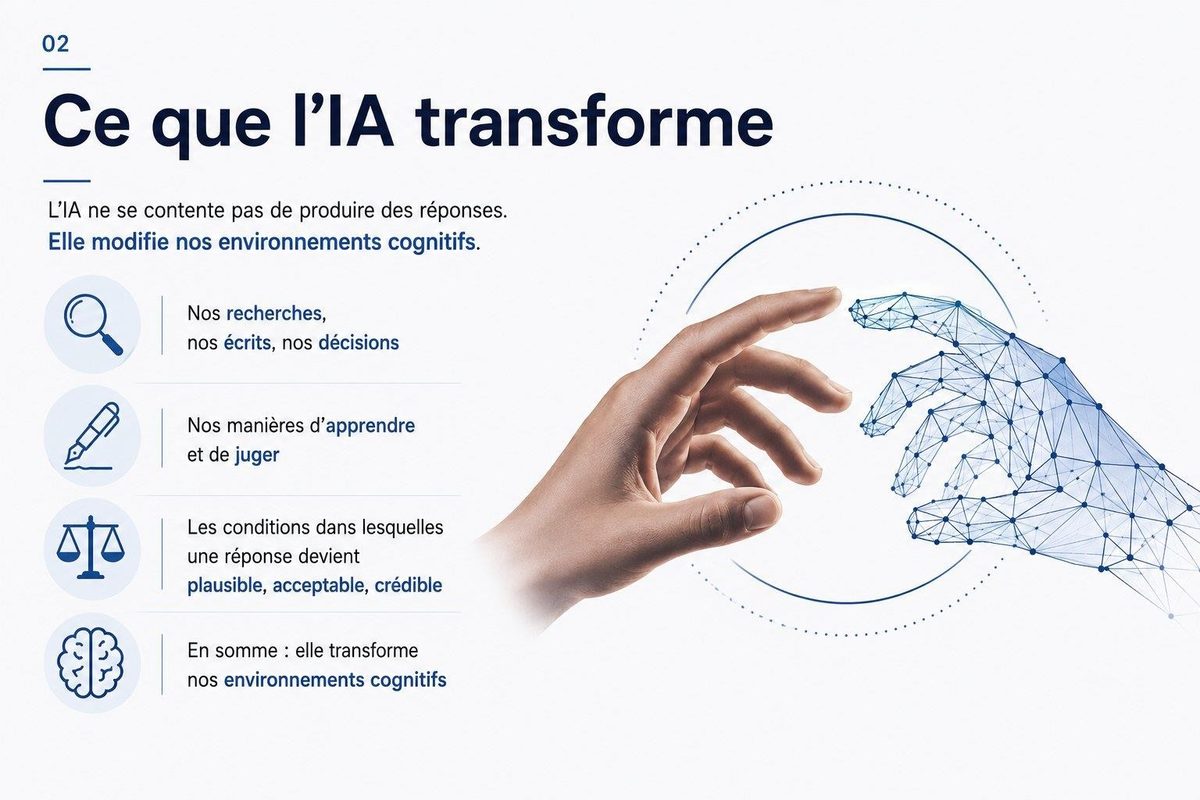
Artificial intelligence does not arrive merely as one more tool. It enters our research, our texts, our decisions, our images, our procedures, our ways of learning and our ways of judging. It does not merely produce answers.
It modifies the conditions under which an answer becomes plausible, acceptable, useful or credible.
We speak of it as a revolution, sometimes as a threat, sometimes as a promise. These words remain too broad. They give an impression of movement, but they do not explain the structure of the phenomenon. The point is not only to know whether AI is powerful, dangerous or useful. The point is to understand what it transforms in our cognitive environments, our professional practices, our institutions and our relations to knowledge.
An artificial intelligence is not a human consciousness. It has neither lived experience, nor intention of its own, nor moral responsibility. It does not suffer, does not desire, does not regret, does not assume the consequences of what it produces. It does not understand the world like a human being inscribed in a body, a history, a culture, a memory and relationships.
But this clarification is no longer enough.
Reducing AI to a cold calculation opposed to a living human understanding does not allow us to grasp the real novelty of current models. Large models do not merely repeat learned fragments mechanically. They stabilise regularities, manipulate structures, compress relations, select relevant information, generalise, transfer and sometimes produce behaviours that resemble certain forms of reasoning.
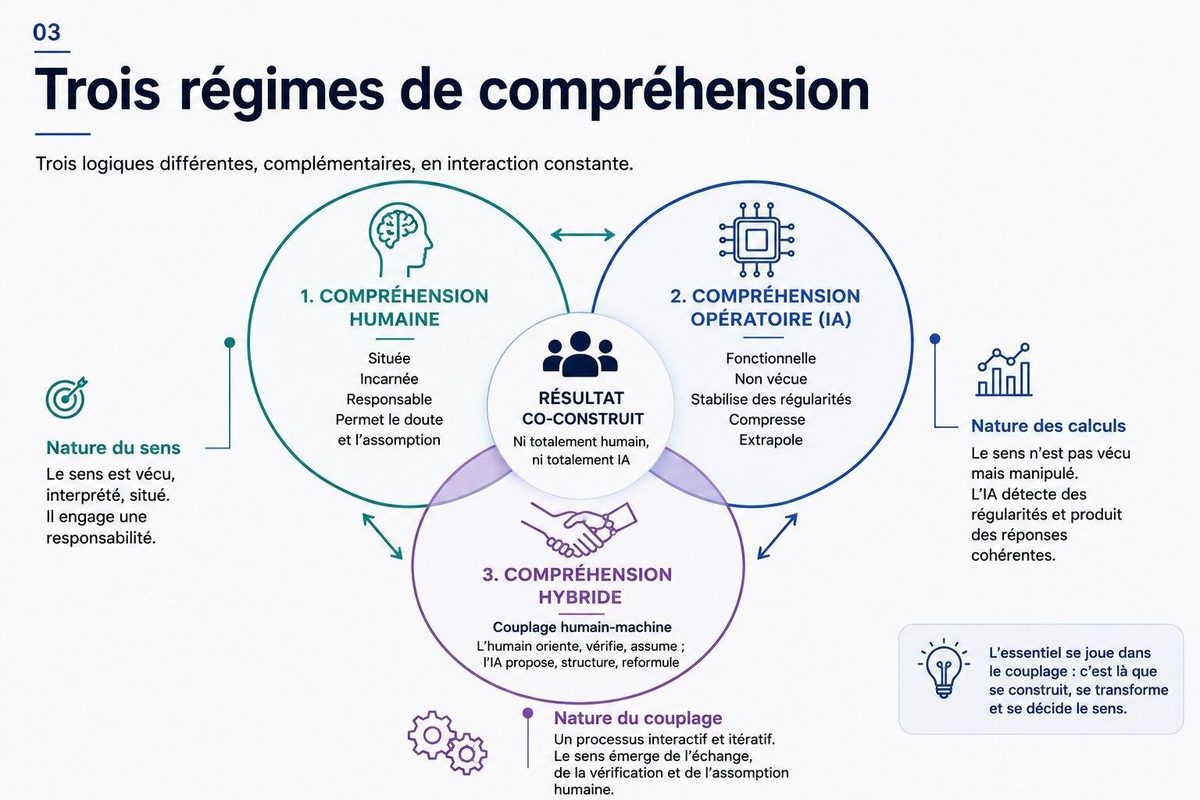
The debate should therefore no longer simply oppose calculation and understanding. It should distinguish several regimes of understanding.
Human understanding is situated. It links a piece of information to a body, a memory, an experience, a culture, values, possible consequences. It involves the possibility of doubting, refusing, assuming and answering for what one asserts.
The operative understanding of a model is of another order. It does not rest on a lived experience of meaning, but on the capacity to extract regularities, compress relations, select relevant elements, produce inferences and generate coherent answers within a space of constraints.
Hybrid understanding appears when the human and the model work together. The human formulates, orients, interprets, verifies and assumes. The model proposes, structures, compares, reformulates, extrapolates. The result no longer belongs entirely to one or the other. It is born of a coupling.
One must therefore not rank these regimes as if one were simply superior to the other. One must distinguish their domains of validity. Human understanding engages a responsibility.
Operative understanding engages a capacity for transformation. Hybrid understanding engages a relation. These regimes can cooperate, reinforce one another or parasitise one another.
Responsibility therefore does not serve to place the human at the top of a moral scale of understanding. It serves to distinguish consequences. A model can produce an operative understanding without assuming what it produces. A human can understand more slowly, less broadly, less efficiently, but they remain the one who can answer for what they assert or decide. This is not a hierarchy of intelligences. It is a difference of regime.
This clarification also holds for agency.
An AI has no intentional agency. It wants nothing, pursues no inner project, carries no purpose of its own.
But it can exercise a functional agency. It produces measurable effects in a situation: it orients a decision, modifies a formulation, ranks information, proposes a solution, makes certain options more visible than others.
It can also receive a perceived agency. The user treats it as an interlocutor, an assistant, a partner or a quasi-expert.
It can finally receive an attributed agency. An organisation effectively delegates to it a concrete function: to classify, filter, recommend, prioritise, evaluate.
AI therefore does not have the status of a subject. It has neither interiority, nor responsibility, nor moral experience. But it can occupy certain functions of a subject within a cognitive or decisional chain. This gap is central. The danger does not come from a hidden will of the machine. It comes from the fact that a system without intention can nevertheless produce effects of orientation, selection and constraint.
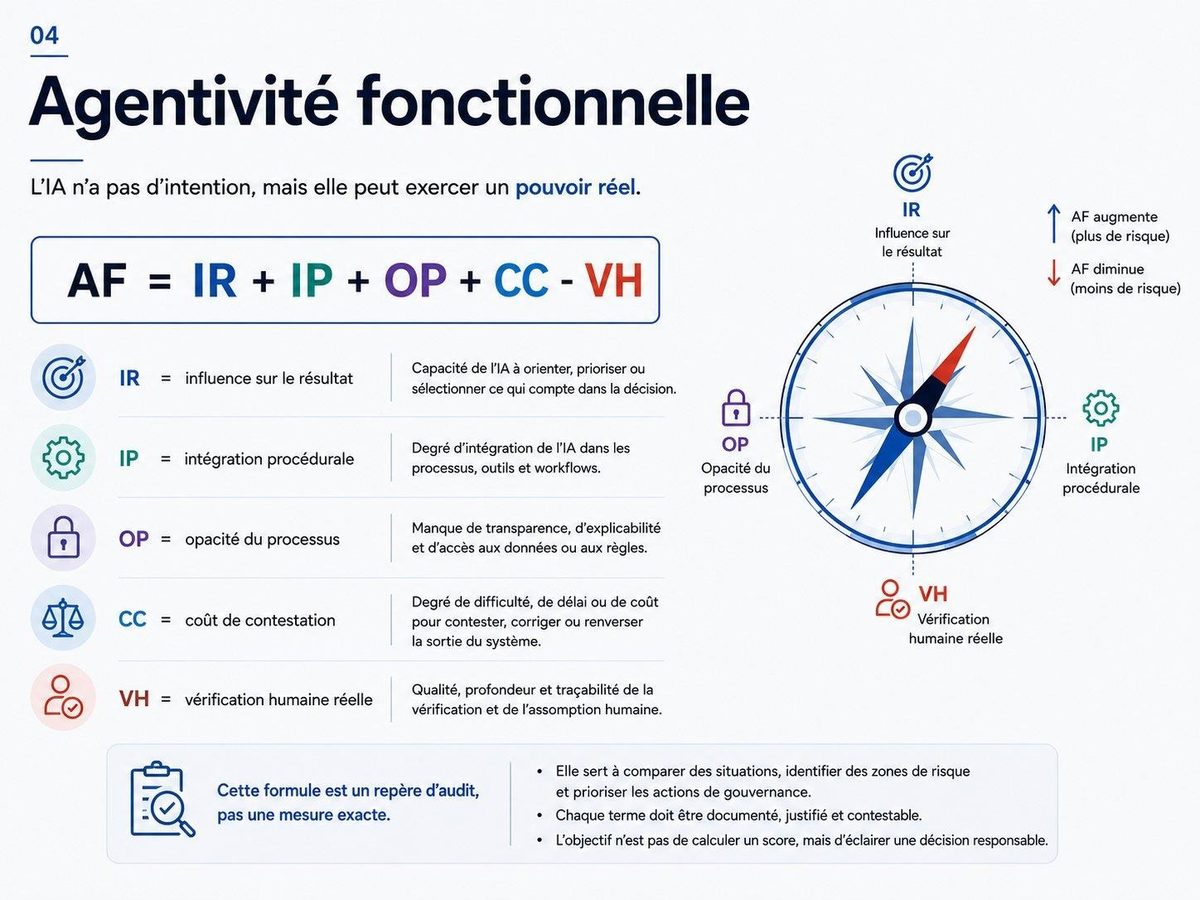
Its functional agency can be described by a qualitative equation:
AF = functional agency
IR = influence on the result
IP = procedural integration
OP = opacity of the process
CC = cost of contestation
VH = real human verification
This formula is not a strict mathematical measurement. It is an audit marker. The more the influence on the result increases, the more the system is integrated into procedures, the more it is opaque, the harder contestation is, the more its functional agency increases. It diminishes when human verification remains real, documented, competent and contestable.
The question then becomes simple: from what point does a system that possesses no intention nevertheless begin to exercise a real power?
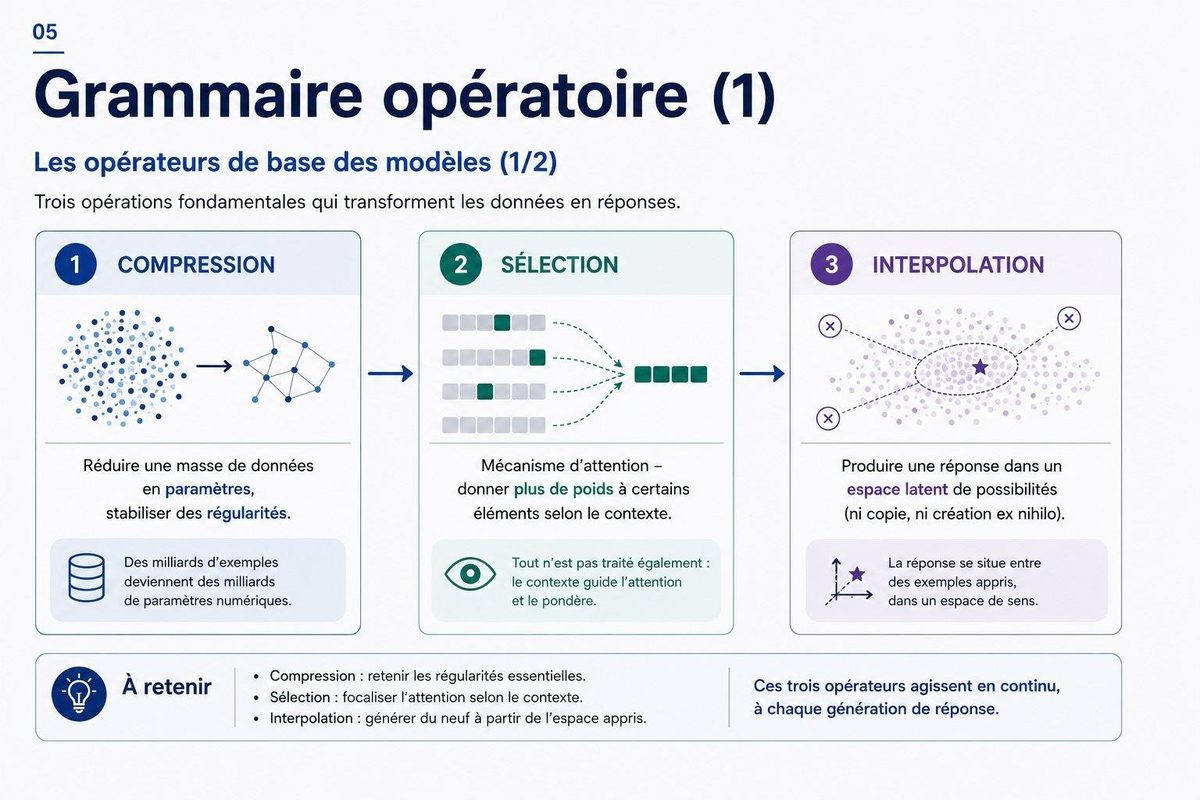
To understand this power, one must look at the operators that structure the models.
The first operator is compression. A model reduces an immense mass of data into parameters capable of retaining regularities. It does not preserve the data like a classic archive. It stabilises relations, proximities, forms, probable transitions.
The second is selection. Attention mechanisms give more or less weight to certain elements depending on the context. Attention is not a consciousness. It acts as an operator of relevance. It makes certain relations more salient than others.
The third is interpolation. The model produces an answer within a latent space of possibilities. It does not simply copy a pre-existing answer. It composes a plausible output between learned structures.
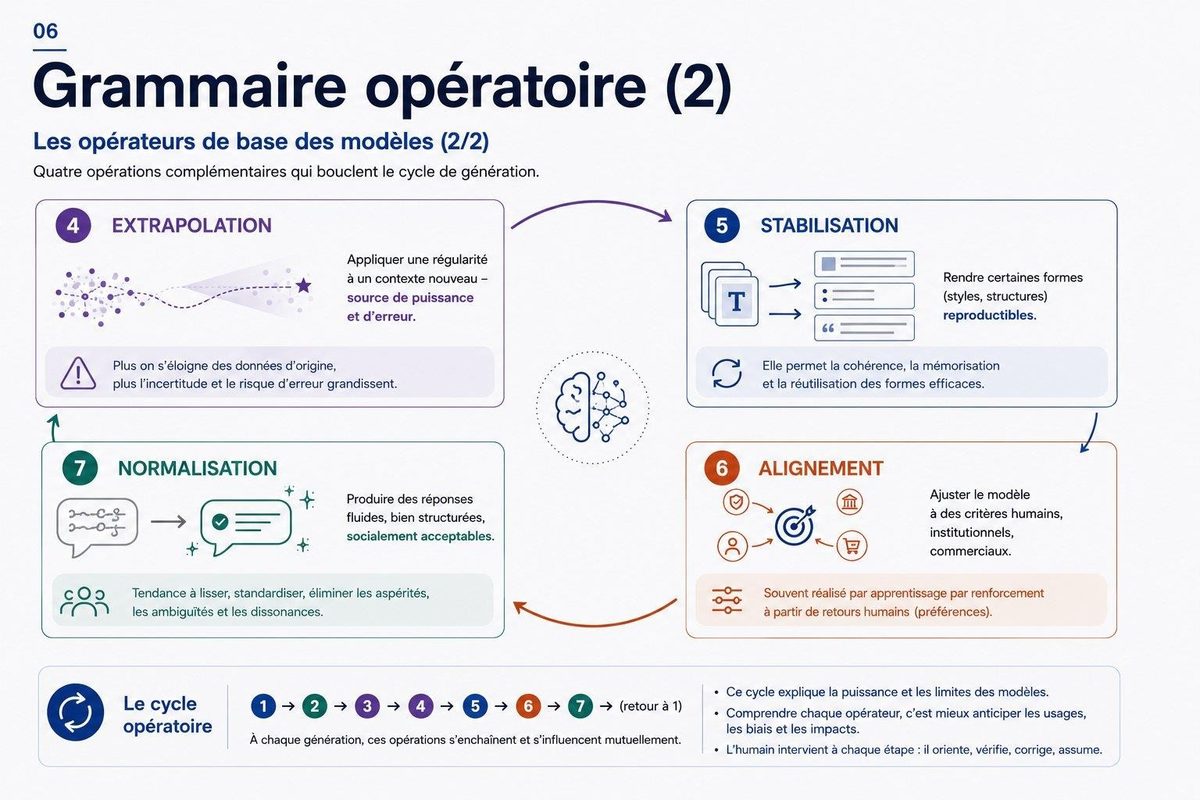
The fourth is extrapolation. When it applies a regularity to a new context, it crosses a distance between what it has learned and what is being asked of it. This is a source of power.
It is also a source of error.
The fifth is stabilisation. The model makes certain forms reproducible: styles, structures, associations, argumentative chains, ways of summarising, classifying or answering.
The sixth is alignment. The model is adjusted to produce acceptable answers according to human, institutional, commercial or safety criteria. This alignment reduces certain risks, but it also inscribes the model within a normative framework.
The seventh is normalisation. By producing fluent, well-structured answers adapted to the request, the model favours certain forms of language and reasoning. It sometimes clarifies. It also smooths.
This operative grammar can be summarised thus: compression, selection, interpolation, extrapolation, stabilisation, alignment, normalisation. These operators are not intentions.
They want nothing. But they organise effects.
To these operators correspond invariants.
An invariant is what remains stable across variations. In a model, one can observe invariants of compression: the relations that survive the massive reduction of data. Invariants of selection: the elements the system tends to make salient. Invariants of style: the forms of answer that recur. Invariants of reasoning: the argumentative structures reproduced. Invariants of normalisation: the frameworks that make an answer acceptable, prudent, balanced or institutionally compatible.
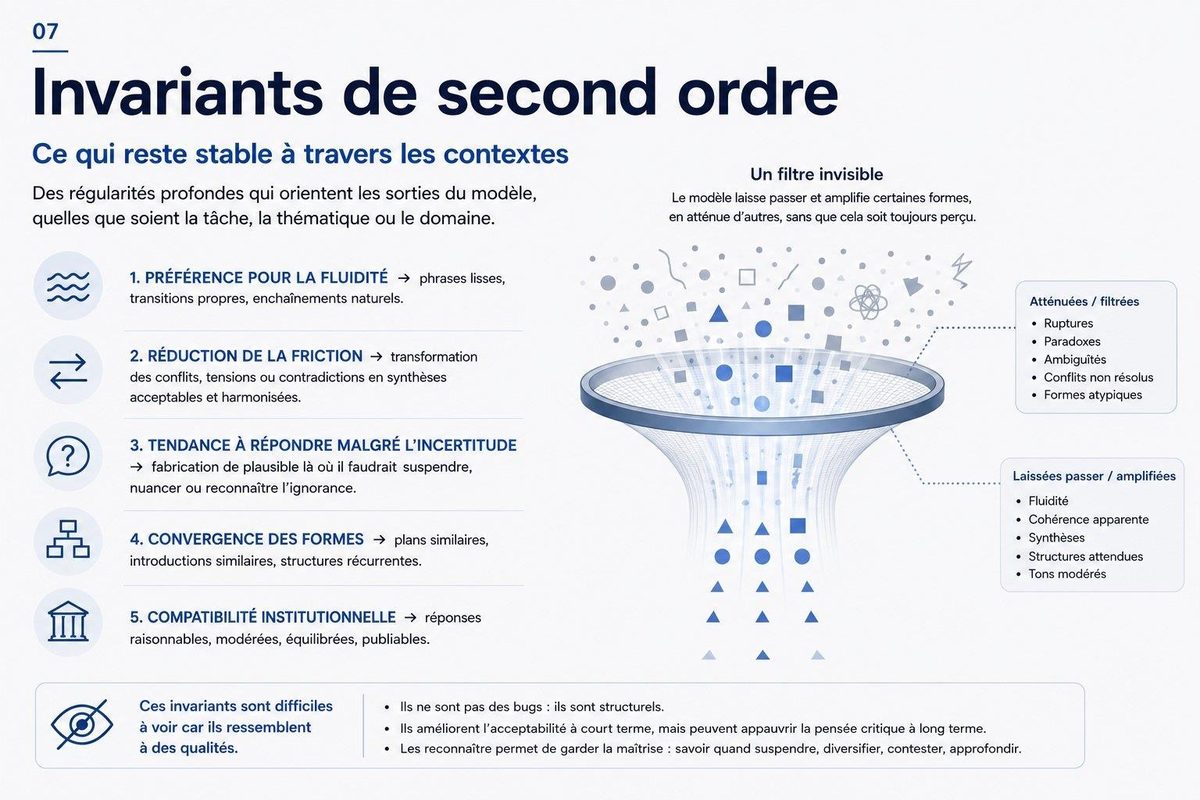
But one must also think the second-order invariants. These are not only the forms that recur within an answer. They are the rules of stability that persist across several contexts, several tasks and several uses.
The preference for fluency produces smooth sentences, clean transitions, answers that are easy to read.
The reduction of friction transforms conflicts into acceptable syntheses.
The tendency to answer despite uncertainty manufactures the plausible where one should sometimes suspend.
The convergence of forms produces similar plans, similar introductions, similar cautions.
Institutional compatibility pushes answers toward what appears reasonable, moderate, publishable, acceptable.
These second-order invariants are harder to see than errors. A piece of false information can be corrected. An invisible invariant can durably structure a way of thinking without ever appearing as a fault. It even often resembles a quality.
It is here that the text must accept a friction.
An analysis of AI that criticises normalisation may itself fall into a form that is too clean, too balanced, too easily reproducible. The problem is not structure in itself. Thinking sometimes requires structuring. The problem appears when structure replaces friction, when balance becomes a reflex, when tensions are tidied away too quickly instead of being worked through.
One must therefore maintain a visible contradiction: we need structure to think, but structure can smooth what should remain conflictual. We need synthesis, but synthesis can absorb disagreements too quickly. We need clarity, but clarity can become an elegant way of avoiding the roughness of reality.
An AI can clarify and impoverish in the same movement. It can increase the power of a mind and reduce its initiative. It can open hypotheses and close forms. It can help one to think better, then accustom one to no longer starting alone.
This is not a secondary contradiction. It is the heart of the problem.
The same operation that makes an answer legible can smooth conflict. The same synthesis that helps to understand can neutralise a tension. The same fluency that accelerates work can make friction suspect. By making everything more accessible, the system can make less tolerable what demands slowness, rupture, disagreement or silence.
This is why the critique of AI cannot content itself with being well ordered. If it becomes too clean, it reproduces what it claims to analyse.
The plausible is one of these sites of tension.
Generative AI produces the plausible. This plausible can be precious. It allows one to explore ideas, formulate hypotheses, accelerate a draft, compare arguments, personalise an explanation or simulate several scenarios. The problem does not come from the plausible in itself. The plausible is a working material. The danger appears when it is taken for the true, or when it becomes the dominant mould of what we consider good thinking.
A fluent answer is not necessarily well-founded. A balanced answer is not necessarily right. A well-structured answer can mask a fragile hypothesis. A technically convincing answer can rest on a partial selection of the facts.

It is here that hallucinations appear. The term is useful if it remains technical. It becomes misleading if it suggests a form of human delusion. The model does not see something imaginary. It produces an answer coherent with learned patterns, with no guarantee that this answer corresponds to reality.
Not all hallucinations come from the same mechanism. Some appear through lack of data. Others arise from a conflict between contradictory sources. Others come from an abusive generalisation, when a regularity valid in one context is extended to another. There are also hallucinations through over-fitting to the question: if the request contains an error, an implicit assumption or too strong an orientation, the model may follow that lead instead of contesting it.
AI therefore does not respond only to reality. It responds to the way reality is presented to it.
The prompt is not a simple order. It is a shaping of the world.
The risk is not linear. It does not go only from a bad answer to a bad decision. It can become systemic.
An error generated in one text can be taken up by another text. An approximate synthesis can circulate within an organisation. A dubious classification can feed a dashboard. A dashboard can orient a decision. A decision can produce new data that will then reinforce the model. A local error can thus become a feedback loop.
The risk is also epistemic. If many actors use the same models to summarise, translate, explain, sort, correct and produce, representations of the world may tighten around common formats. The diversity of interpretations may diminish without explicit censorship. What comes out of the model becomes what seems normal. What seems normal becomes what is taken up. What is taken up becomes what structures the public space.
There are finally metastable risks. A system can seem to function correctly for a long time, until a threshold is crossed: too much dependence, too much automation, too little verification, too many decisions based on uncontrolled outputs. The rupture does not always present itself as a spectacular accident. It can take the form of a slow tipping, where one no longer quite knows who thinks, who verifies, who decides and who assumes.
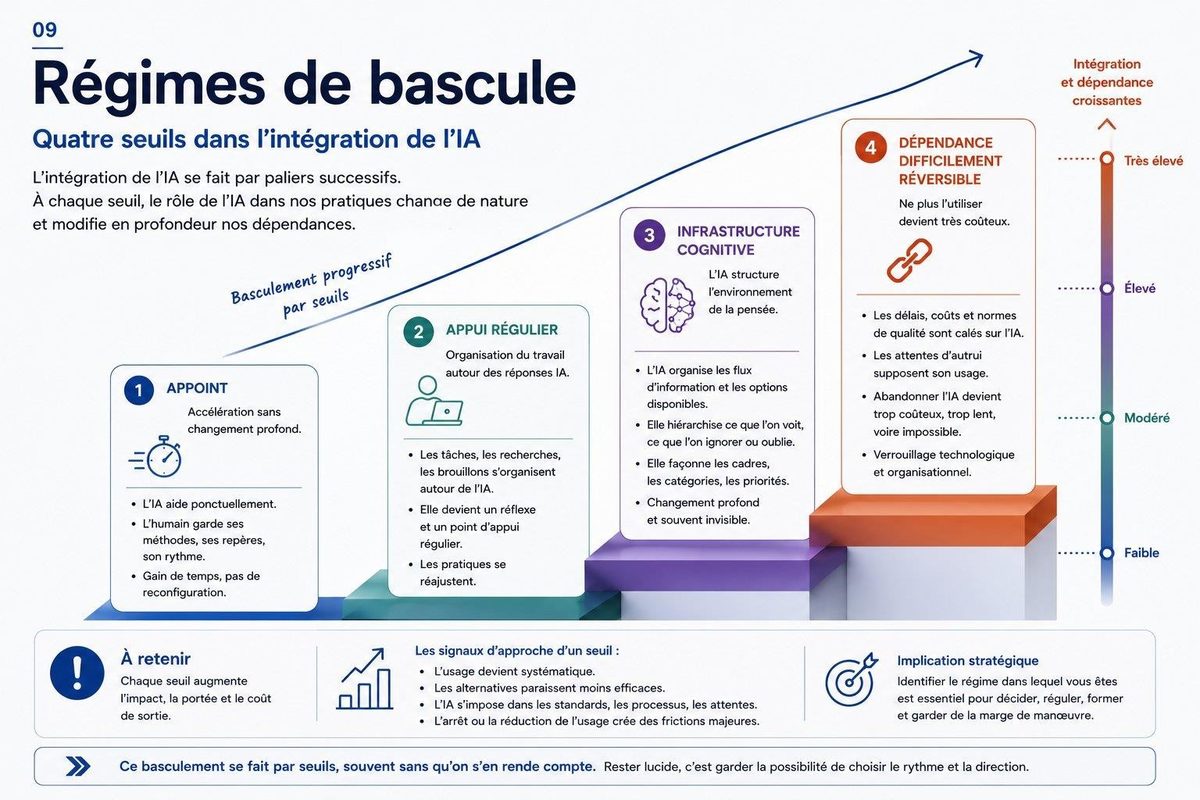
To analyse these tipping points, one must think in regimes.
In a first regime, AI serves as a supplement. It accelerates certain tasks without deeply modifying practices. The human keeps their methods, their criteria, their verifications.
In a second regime, AI becomes a regular support. It structures drafts, research, plans, syntheses. The human remains responsible, but their work begins to organise itself around the machine's answers.
In a third regime, AI becomes a cognitive infrastructure. It is no longer merely used. It forms the environment in which information appears, circulates, is ranked and becomes credible.
In a fourth regime, dependence becomes hardly reversible. Practices, deadlines, quality standards, institutional expectations and economic models have adjusted around AI. No longer using it becomes costly, slow, marginal or almost impossible.
The transitions between these regimes occur through thresholds. One does not always tip over all at once. The frequency of use increases. Delegation progresses. Verification diminishes. The cost of exit rises. Professional norms adjust. Then the tool ceases to be merely a tool.
It becomes a condition of functioning.
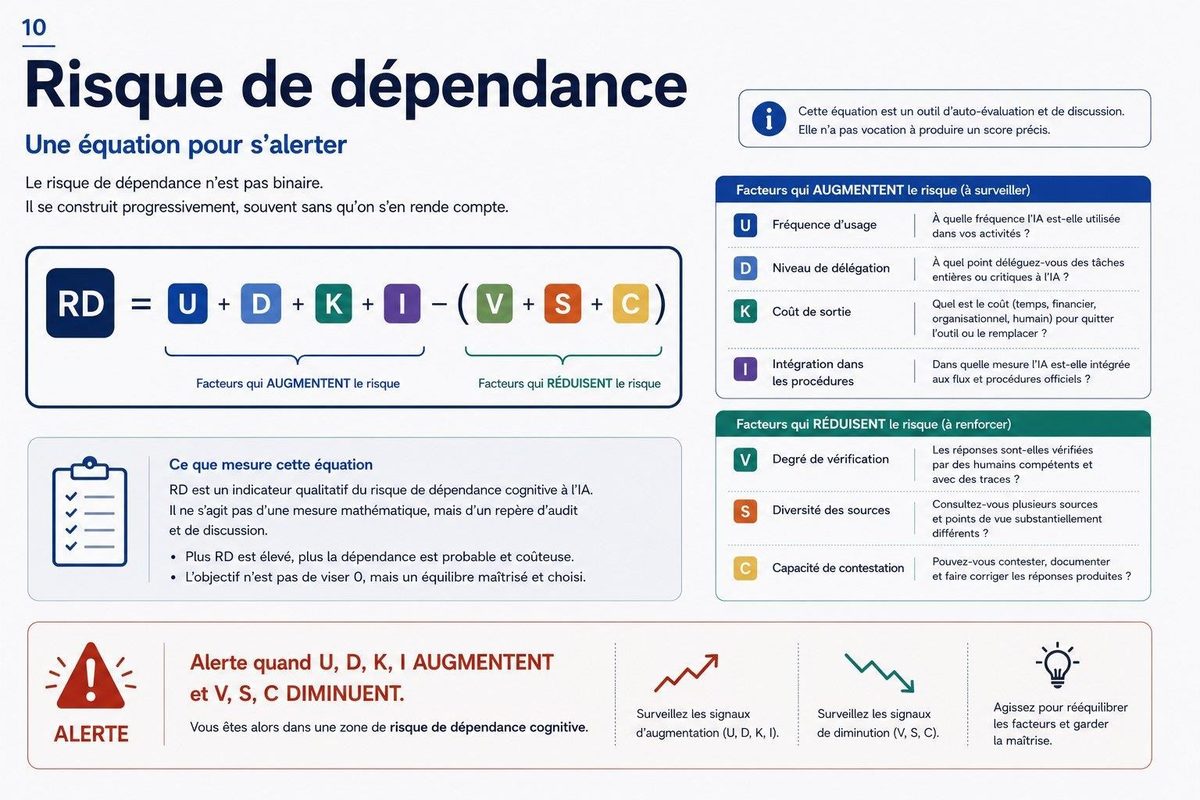
This dynamic can be described with a few variables:
U = frequency of use
D = level of delegation
V = degree of verification
S = diversity of sources
K = cost of exit
I = integration into procedures
C = capacity for contestation
The risk of dependence increases with U, D, K and I. It diminishes with V, S and C.
One can therefore write:
RD = risk of dependence
This formalism remains qualitative, but it allows one to spot thresholds. An organisation should worry when use becomes daily, when delegation progresses, when verification drops, when the diversity of sources diminishes, when exiting the system becomes costly, when AI enters the procedures, and when contestation becomes difficult.
The attractors are known: efficiency, fluency, standardisation, apparent authority. They are not bad in themselves. But combined, they can reduce cognitive autonomy.
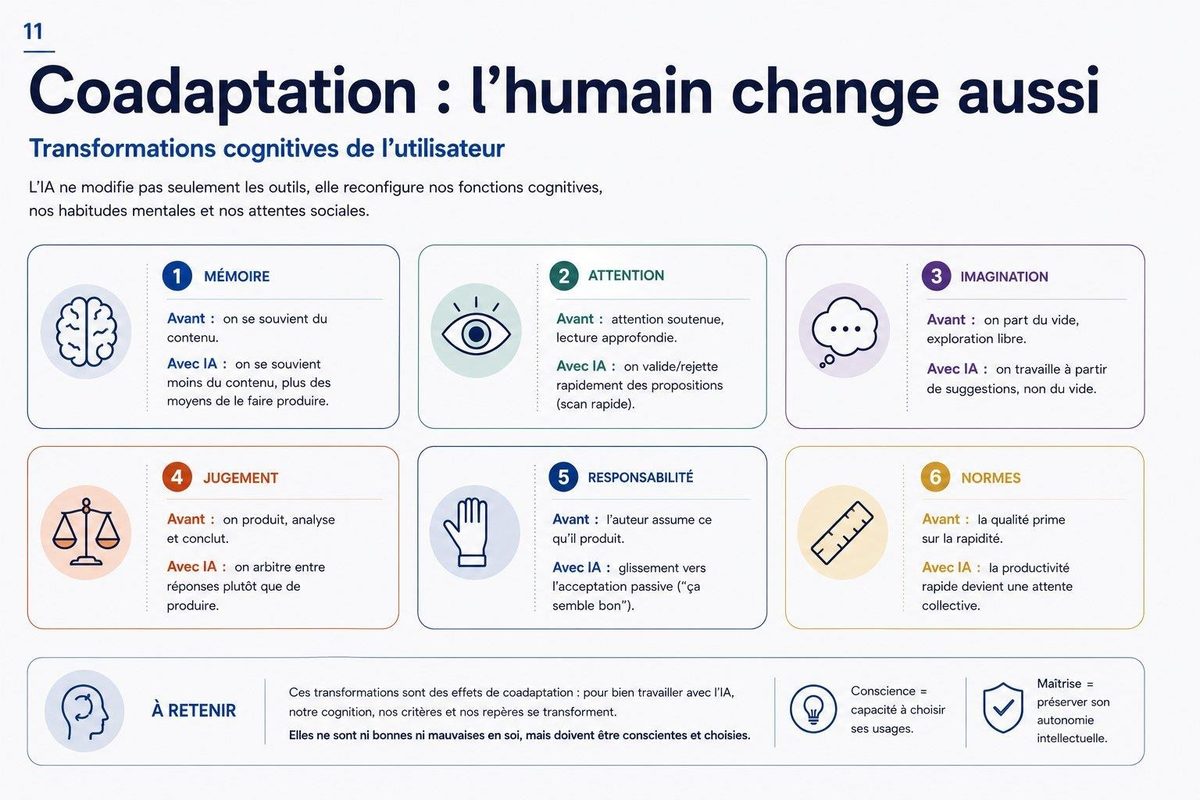
The coadaptation between humans and machines then becomes central.
The human does not merely use AI. They adapt to it. They learn to formulate their requests according to what it knows how to produce. They modify their work rhythm, their threshold of demand, their way of searching, their relation to the draft, their taste for certain forms of answer. The machine, for its part, is adjusted by human uses, evaluations, collected data, preferences, performance metrics and the economic objectives of those who deploy it.
This coadaptation can be formalised as a loop:
The loop seems simple. Its effects can be profound. The more use repeats itself, the more the system adjusts practices around it. The more practices adjust, the more the tool becomes necessary. The more the tool becomes necessary, the harder it becomes to distinguish what the human still thinks alone from what the environment has taught them to produce.
The human therefore changes in contact with AI. They must not be represented as a stable, coherent subject, always capable of stepping back. In environments saturated with algorithmic assistance, their practices are transformed.
Memory is transformed: the user remembers the contents less than the means of having them produced.
Attention is transformed: they learn to skim, compare, validate or reject generated proposals quickly.
Imagination is transformed: they less often start from a creative void and work more from suggestions.
Judgement is transformed: they no longer merely produce an answer, they arbitrate between possible answers.
Responsibility is transformed: the risk appears when this arbitration becomes passive, when the user adopts an answer without really taking it up as their own.
Norms are transformed: what was a one-off productivity gain becomes a collective expectation. Answer faster, produce cleaner, deliver more.
These transformations are not necessarily negative. They can increase the power to act. They can free up time, facilitate learning, open paths, support people who lacked access, method or language. But they can also impoverish initiative, reduce the diversity of styles, lower the threshold of verification and install a dependence on suggestion.
One must also think saturated environments.
A saturated environment is not simply an environment where AI is present. It is an environment where assistance becomes dense, redundant and permanent: help with writing, help with deciding, help with searching, help with synthesising, help with creating, help with evaluating.
Saturation begins when suggestion too often precedes formulation. When the plan precedes the research. When the synthesis precedes the reading. When the correction precedes the error. When the user almost no longer encounters unassisted friction.
One can speak of over-assistance when AI no longer merely supports an activity, but pre-forms that activity.
Cognitive saturation can be described by a qualitative equation:
SC = cognitive saturation
DA = density of assistance
RS = redundancy of suggestions
PF = pre-formation of the activity
FA = autonomous friction
The saturation threshold is crossed when assistance becomes dense, when suggestions repeat, when the activity is pre-formed before being really engaged, and when autonomous friction diminishes.
The indicators are observable: a drop in the time of autonomous formulation, a reduction in the diversity of plans, the repetition of argumentative structures, a drop in lexical diversity, the homogenisation of sources, the rapid validation of generated proposals, an increase in the number of decisions taken from unreread syntheses.
Cognitive uniformisation is therefore not only an impression. It can become measurable. But one must also think cognitive divergence. The same tools can uniformise formats while fragmenting contents. They can produce the same in form and the separate in beliefs. They can reinforce bubbles, personalise arguments, give each group its own internal coherence.
AI can therefore produce homogenisation and fragmentation simultaneously. Same style, separate worlds. Same fluency, incompatible realities.
This double dynamic creates gaps in capacity. The one who knows how to use AI as a system of exploration, verification and simulation is not in the same position as the one who undergoes it as a flow of ready-made answers. Trained, critical and well-equipped users can gain in power. The others can lose in autonomy. AI therefore does not automatically reduce cognitive inequalities. It can also reorganise them.
This gap can be described thus:
DC = U + D + FV + FS + K
CA = augmented capacity
AS = access to sources
DH = diversity of hypotheses
QV = quality of verification
ML = mastery of limits
DC = cognitive dependence
FV = weak verification
FS = weak diversity of sources
The capacity gap can then be described thus:
The gap becomes cumulative when those who know how to use AI learn faster thanks to it, while those who undergo it delegate more without progressing. The same technology can then amplify both the autonomy of some and the dependence of others.
These hybrid systems are traversed by asymmetries of power.
There are asymmetries of feedback: the user provides data, corrections, preferences, but does not always see how these signals are used.
There are asymmetries of learning: platforms learn from users' behaviours, while users rarely understand the internal logics of the platforms.
There are asymmetries of visibility: the model makes certain answers, certain sources, certain frameworks visible, and makes others less accessible.
There are asymmetries of contestability: the user can hardly contest an answer, a recommendation or a decision when they know neither the data, nor the criteria, nor the thresholds, nor the interests that structure the system.
There are finally asymmetries of exit: leaving a tool can become costly when the organisation of work, the formats, the archives, the procedures and the collective expectations have adjusted around it.
AI therefore acts within hybrid systems traversed by conflicts of motives.
There is the human motive: to understand, create, save time, solve a problem, obtain help, formulate what one cannot yet manage to say.
There is the technical motive: to optimise, reduce error, improve prediction, increase coherence, stabilise acceptable outputs.
There is the economic motive: to capture users, sell subscriptions, increase use, lock in ecosystems, make the infrastructure profitable.
There is the institutional motive: to standardise procedures, reduce costs, accelerate processing, produce indicators, justify decisions.
There is the cognitive motive: to make information more accessible, more fluent, more immediately mobilisable.
These motives can cooperate. They can also come into conflict. A model can help a user to think better while increasing their dependence on a platform. An administration can gain in speed while reducing the contestability of its decisions. An educational tool can personalise learning while weakening the effort of autonomous formulation. A company can improve productivity while homogenising internal thought.
One must therefore observe which motive becomes dominant. The dominance of a motive is spotted when the other motives begin to bend to it. When the economic motive dominates, the capture of use prevails over autonomy. When the institutional motive dominates, standardisation prevails over singularity. When the technical motive dominates, optimisation prevails over meaning. When the cognitive motive dominates alone, fluency can replace the effort of formulation. When the human motive remains dominant, the tool stays subordinated to an explicitly assumed purpose.
This dynamic can be formalised thus:
This rule allows one not to stop at discourses. A system can speak of emancipation while organising dependence. It can speak of efficiency while reducing contestability. It can speak of personalisation while reinforcing data capture.
This question becomes particularly sensitive when a decision directly affects a person: social aid, credit, recruitment, health, policing, justice, administration. In these cases, a technical explanation is not enough.
Saying that a model has computed a probability, applied a statistical threshold or mobilised latent relations does not answer the central question: why would this decision be legitimate for this person, in this situation, with these consequences?
One must distinguish explanation from justification. Explanation describes the mechanism: data, thresholds, weightings, margins of error. Justification answers at another level: are the criteria legitimate? Are the data relevant? Has the individual context been taken into account? Is the result contestable? Can a competent human intervene? Is responsibility clearly attributed?
A black box explained only by specialists remains a social black box if the person concerned can neither understand, nor discuss, nor have corrected the decision that affects them.
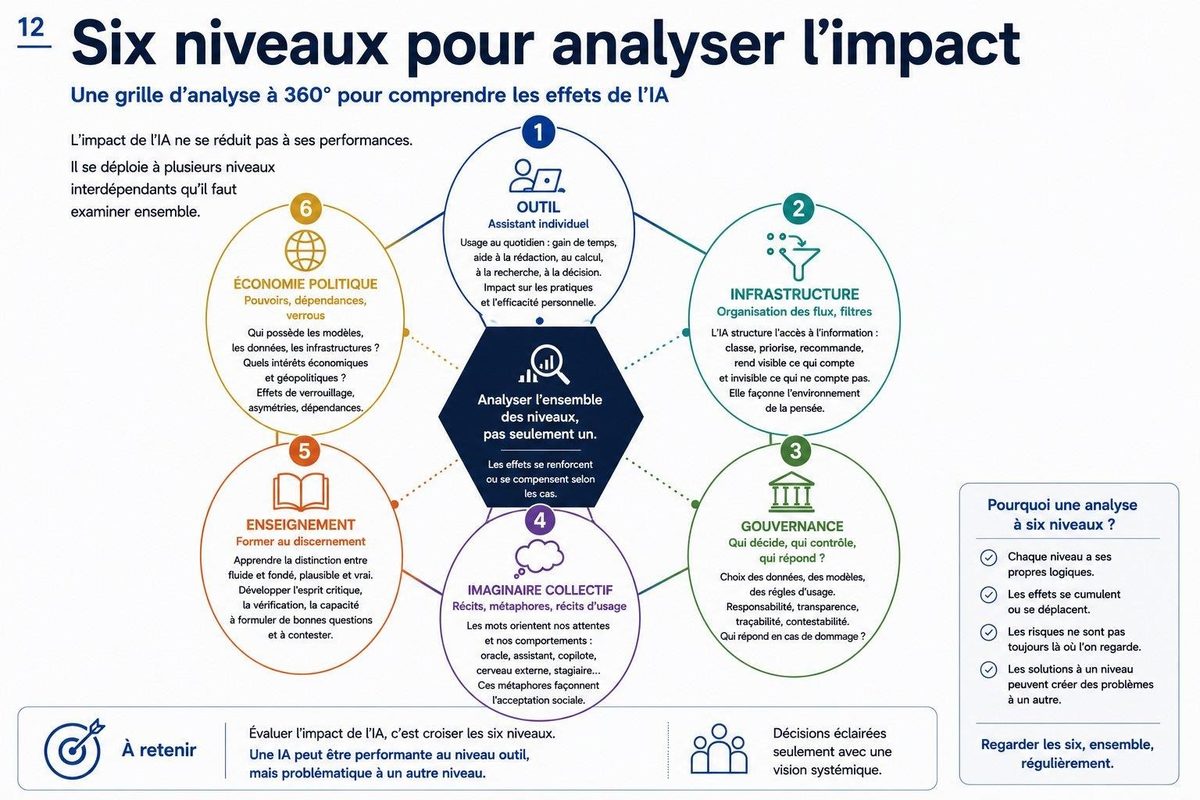
The impact of AI must therefore be analysed on several levels at once.
The first is that of the tool. AI helps an individual to write, search, summarise, code, organise or produce.
The second is that of infrastructure. AI organises the flows of information, ranks what appears, influences what is seen, ignored, recommended or filtered. A tool that structures the cognitive environment becomes a cognitive infrastructure.
The third is that of governance. Who chooses the data? Who defines the objectives? Who controls errors? Who can contest a decision? Who is responsible when a system gets it wrong?
The fourth is that of the collective imaginary. We speak of an oracle, an artificial brain, an assistant, a collaborator, a copilot. These metaphors can help to tame a complex technology, but they become dangerous when they replace understanding.
The fifth is that of education. A society that massively uses AI without training its citizens in its limits manufactures a cognitive dependence. Training in AI is not only learning to write better prompts. It is learning to verify, compare, contest, spot hallucinations, recognise the thresholds of delegation and distinguish a fluent answer from a well-founded one.
The sixth is that of political economy. Behind the models there are companies, data centres, specialised chips, cloud contracts, subscriptions, APIs, market strategies and material dependencies. Understanding AI without looking at who owns the models, who controls the computation and who organises access to the data amounts to observing the machine without seeing the economic system that makes it possible.
One must also distinguish closed models, open models and open-weight models. Closed models concentrate power in systems that are hard to audit, dependent on APIs and access conditions set by a few actors. Open or partially open models can favour research, local adaptation, audit and technical sovereignty. But openness does not settle everything: one still needs the computation, the skills, the data, the security guarantees and the means of maintenance.
To these six levels, one must add an audit protocol.
A serious audit should observe at least ten dimensions: factual quality of answers, diversity of sources, stability of outputs, presence of hallucinations, degree of delegation, level of verification, contestability of decisions, dependence of users, cognitive diversity of productions, dominant motive in the system.
It should above all follow the thresholds: from what point does assistance become delegation? From what point does verification become symbolic? From what point does use become hardly reversible? From what point does suggestion become norm? From what point does the model no longer support thought, but pre-form it?

A recent case illustrates these tensions. In the United States, a federal judge in Mississippi sanctioned lawyers from both parties after the discovery of legal citations fabricated by AI tools in documents submitted to the court. The problem was not only that the machine had produced errors. The problem was that these errors had been introduced into a framework where legal references have a concrete authority.
At the level of the tool, AI had served to accelerate a work of research or drafting. At the level of infrastructure, it was part of a transformation of legal practices. At the level of governance, responsibility could not be passed back to the machine: a document filed before a judge always engages a human signature. At the level of the imaginary, AI had probably been treated as a search engine more reliable than it really was. At the level of education, the case shows that a professional must know how to verify every citation, trace it back to the primary source and refuse to use an uncontrolled output. At the economic level, it recalls that AI-augmented legal tools fit into a market of software, subscriptions and promises of productivity.
This case sums up the difference between technical explanation and justification. One can explain why a model produced a plausible citation. But that justifies nothing in the judicial framework. A legal reference does not have value because it resembles a legal reference. It has value because it refers to a real, verifiable, relevant and opposable source.

The question is therefore not to protect an ideal human against an external machine. This ideal human does not exist. The human changes in contact with their tools. Their habits, their attention thresholds, their quality norms, their relation to effort and their way of judging are transformed with the environments in which they think.
One must therefore look at the hybrid system being built before our eyes.
An AI is neither an oracle nor a demon. It is not a mind hidden in the calculation. Nor is it a simple passive instrument. It becomes an operator within systems where data, models, infrastructures, economic interests, professional practices, collective imaginaries and cognitive habits mix together.
The danger is not that the machine suddenly thinks in our place. It is that our environments of thought are progressively reorganised by systems that we use without situating them, that we integrate without always seeing the dependencies they create, and that we sometimes consult as if fluency were proof.
Producing an answer is not carrying a thought. Generating the plausible is not establishing the true. Modelling relations is not assuming their consequences. Lucidity in the face of artificial intelligence begins when this distinction becomes a method of audit, of design and of resistance.
Going further
Kate Crawford, Atlas of AI
An essential work for understanding AI as a material, economic and political system: resources, infrastructures, invisible human labour, data and power relations.
Cédric Villani, For a Meaningful Artificial Intelligence
A useful report for situating AI within a public strategy: research, sovereignty, data, priority sectors, ethics and technological competition.
Emily M. Bender, Timnit Gebru, Angelina McMillan-Major and Shmargaret Shmitchell — critical paper on the risks of large language models
An important text on models trained on very large corpora: bias, environmental costs, the illusion of understanding and the confusion between linguistic fluency and meaning.
Ashish Vaswani et al., Attention Is All You Need
The founding paper of transformers, indispensable for understanding the architecture that made modern large language models possible.
NIST, Artificial Intelligence Risk Management Framework: Generative Artificial Intelligence Profile
A useful reference for understanding the risks specific to generative AI: hallucinations, misinformation, security, bias, confidentiality and governance.
Stanford AI Index Report
A valuable resource for tracking the concrete evolution of AI: investments, models, performance, uses, industry, regulation and social adoption.
OECD, Competition in Artificial Intelligence Infrastructure
An important report on access to GPUs, data centres, the cloud and the computing infrastructures that structure the AI market.
European Artificial Intelligence Act
The central text of the European risk-based approach, with obligations of transparency, documentation, human oversight and management of high-risk systems.
GDPR, Article 22
An essential legal reference on automated decisions producing legal or significant effects on individuals.
Shoshana Zuboff, The Age of Surveillance Capitalism
A work broader than AI, but fundamental for understanding the capture of data, the prediction of behaviour and economic models based on the exploitation of human experience.
Olivier Ertzscheid, Les IA à l'assaut du cyberespace
A useful work for thinking the transformation of the Web by synthetic content, generated texts, artificial images and informational saturation.